What is a healthy BMI for South Asian adults?


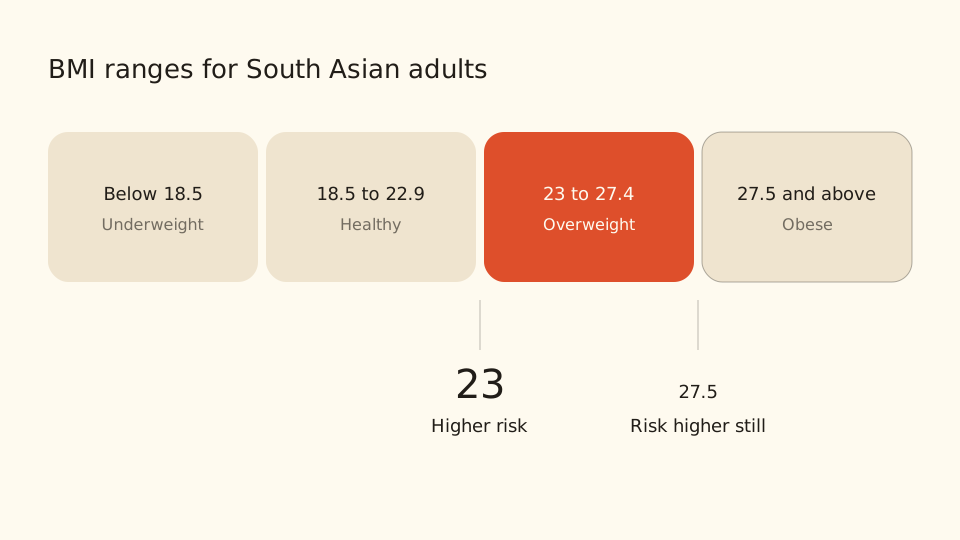
For South Asian adults, a healthy BMI is 18.5 to 22.9. Health risks start at a slightly lower BMI if your family background is South Asian, so you count as overweight sooner than the standard chart suggests. Below are the UK numbers, the reason they’re lower and what to check once your BMI reaches 23.
Why are the BMI cut-offs lower for South Asian adults?
Because risk starts at a lower BMI. Many Asian people face a high risk of type 2 diabetes and heart disease at a BMI below 25, the standard point for overweight. BMI is a quick screen, so where the line sits decides who gets a second look.
The point where risk rises isn’t the same in every Asian population. So the international advice keeps the usual cut-offs and adds extra points at which to act, instead of one new cut-off.
In the UK, the overweight line for adults of South Asian background is 23, and the obese line is 27.5. The same lower cut-offs apply to people of some other ethnicities too: Chinese, other Asian, Middle Eastern, Black African or African-Caribbean.
Is a BMI of 24 overweight for South Asian adults?
Yes, though only just. A BMI of 24 sits in the overweight band on the South Asian ranges, so it helps to know how far over the line you are.
Here’s the sum for one person, worked through:
- You’re 1.62 m tall (about 5 ft 4) and weigh 63 kg (just under 10 stone).
- Your BMI is 63 ÷ (1.62 × 1.62), which comes to 24.
- On the standard chart that’s healthy, because it’s under 25 (for anyone not South Asian).
- On the South Asian ranges it’s overweight, because it’s 23 or more.
- At your height, a BMI of 23 is about 60.4 kg, so you’re 2.6 kg over the line.
- At the same height, a BMI of 27.5 is about 72.2 kg, over 9 kg away.
So the same body sits on different sides of the line, depending on the chart. At 2.6 kg over, you’re near the bottom of the band, much closer to healthy than to obese.
To work out your own BMI, divide your weight in kilograms by your height in metres. Then divide the answer by your height again.
Does a lower cut-off mean I am unhealthy at a normal-looking weight?
No. The lower line marks a higher risk of health problems, which is a different thing from being unwell now. Those problems include type 2 diabetes and heart disease.
What else should I check besides BMI?
Check your waist and your family history. A tape measure shows what BMI doesn't tell you, which is how much weight sits around your middle, your abdominal circumference actually says a lot. Measure this at the midpoint between your ribs and your hip bone. If you’re a woman, there’s more on what a healthy waist size is and what your reading means.
If your BMI is 23 or more, or type 2 diabetes runs in your family whatever your BMI, ask your GP practice about a blood test for diabetes.
If you want to bring your BMI back under 23, start with changes small enough to keep:
- Walk briskly most days. Brisk walking counts as moderate activity, and 150 minutes of it a week meets the target for adults. Is walking enough exercise? goes further.
- For the starch, pick the higher fibre or wholegrain kind, such as brown rice or wholemeal chapatti, and see how much fibre a day to aim for.
- Write down your BMI and your waist today, so you have your own starting point to compare against. Then decide how often to weigh yourself.
Sources
- Overweight and obesity in adults
- WHO Expert Consultation. Appropriate body-mass index for Asian populations and its implications for policy and intervention strategies. The Lancet, 2004.