What is a healthy waist size for a woman?


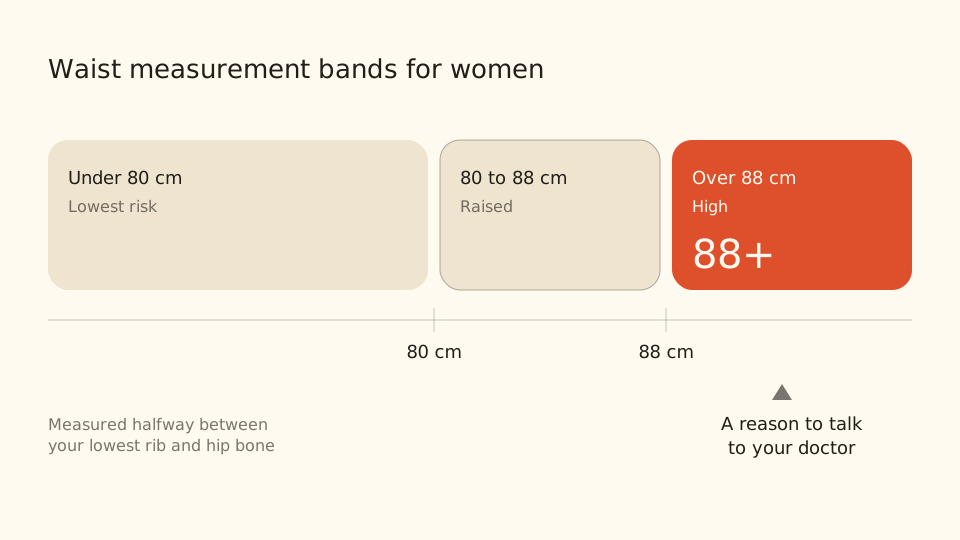
For a woman, a waist under 80 cm (31.5 inches) is in the lowest risk band. From 80 cm the risk is raised, and over 88 cm (34.6 inches) it is high, the level at which to act sooner on your weight. A simpler check that allows for your height is to keep your waist to less than half your height. Here is how to measure it and which number to trust.
What is a healthy waist size for a woman in the UK?
The 80 and 88 cm lines come from a study of 1,014 women and 904 men in North Glasgow, where a waist of 88 cm or more picked out women with a BMI of 30 or over, and 80 cm picked out those with a high BMI or a lot of weight carried round the middle.
Your waist tells you something your weight does not. In a large study of about 26 million adults, each 10 cm more round the waist went with a 61 per cent higher risk of type 2 diabetes, whatever the BMI.
How do you measure your waist properly?
Measure at the midpoint between your ribs and your hip bone. Not at your belly button, and not where your trousers sit. Here is how to do it at home:
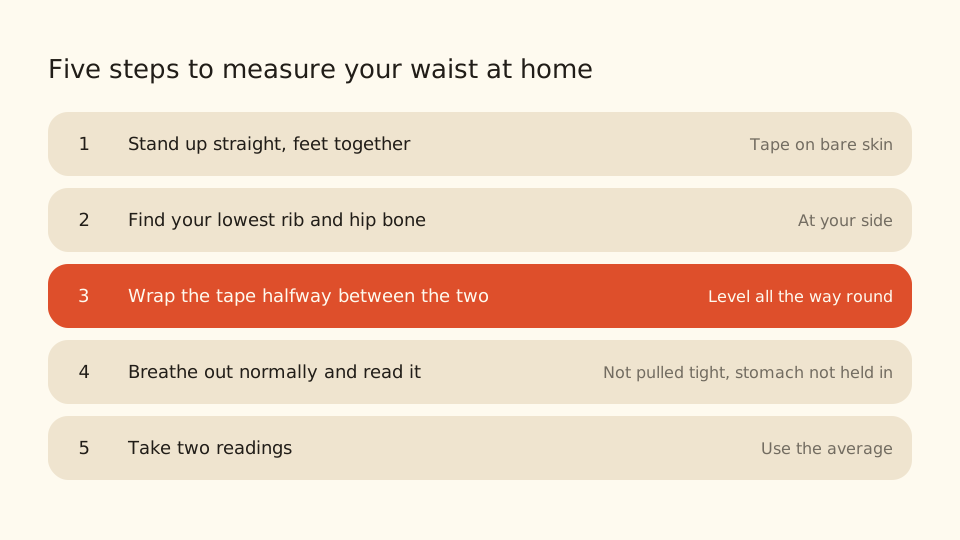
Measure in the morning before breakfast, because a big meal or a bloated afternoon can move the reading enough to put you over a line you are not really over.
Waist, height or hips: which number should you use?
Your waist to hip ratio is your waist divided by your hips, measured round the widest part. In research following about 2.5 million people, a larger ratio went with a higher risk of death over the years they were followed, and so did a larger waist and a higher waist to height ratio, even after allowing for BMI. For checking at home, the waist to hip ratio adds little that the half your height rule tells us.
What should you do if your waist is above the range?
Check the reading first. Measure again on another morning before having a meal.
If the second reading is still over half your height, or over 88 cm, act on it. That 88 cm mark is the level set to flag that someone needs help with their weight. It isn’t an emergency, but it is a good reason to book a routine GP appointment and talk about your weight. Before you go, you can read what weight support the NHS offers and how walking fits in.
Then choose a date about four weeks away and measure again, the same way. Write both numbers down, as you might when weighing yourself. If you are on a weight loss journey these numbers can be a powerful tool to keep yourself on track.
Sources
- Lean et al. Waist circumference as a measure for indicating need for weight management. BMJ, 1995.
- Obesity (NHS)
- Waist circumference and waist-hip ratio: report of a WHO expert consultation
- Jayedi et al. Anthropometric and adiposity indicators and risk of type 2 diabetes: systematic review and dose-response meta-analysis of cohort studies. BMJ, 2022.
- Ashwell et al. Waist-to-height ratio is a better screening tool than waist circumference and BMI for adult cardiometabolic risk factors: systematic review and meta-analysis. Obesity Reviews, 2012.
- Jayedi et al. Central fatness and risk of all cause mortality: systematic review and dose-response meta-analysis of 72 prospective cohort studies. BMJ, 2020.