How to stop snacking in the evening, step by step

To stop snacking in the evening, first work out whether the urge is hunger or habit, because each needs a different fix. If you had a thin lunch and a small, early dinner, it’s probably hunger, and the fix is to eat more earlier in the day. Willpower at 9pm won’t make up for it.
If it’s habit, change the cue and the routine around it. A flat rule of no food after dinner is the weakest place to start: in a year-long study, advice to avoid late-evening snacks made no clear difference to body composition.
Why do I snack in the evening?
Most evening snacking is either real hunger or a habit tied to a time and a place. Hunger is likely when lunch was a sandwich at your desk and dinner was small and early. Habit is the biscuit that comes out with the television, whatever you ate.
Your body clock seems to play a part too. Night owls, people with a later chronotype, tend to have more night eating, binge eating and food cravings, and poorer sleep goes with eating that feels out of control. How well you sleep matters more than how long. So if your nights are late and restless, that’s a reasonable place to look: a steadier bedtime is worth trying for its own sake.
Is it hunger or habit, and how can I tell?
You can usually tell on the night. Before you open the cupboard, ask yourself:
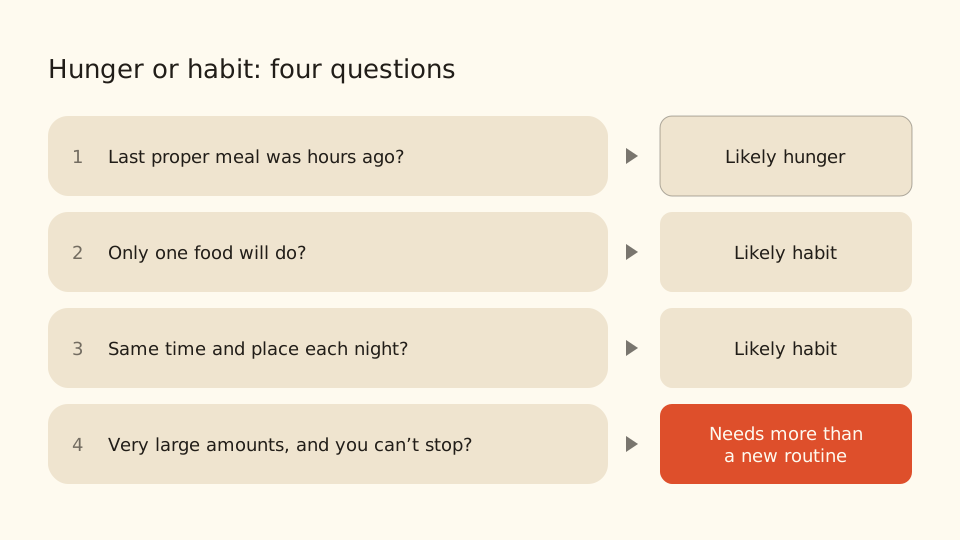
How to stop snacking in the evening: what helps in the moment?
If it’s hunger, eat something. Make it a small meal you sit down for, on a plate, rather than a packet eaten standing at the cupboard. It’s a late meal, so treat it as one. If it’s habit, break the link between the cue and the food with a short routine:
- Leave the room the urge started in, even for five minutes.
- Do one small thing that marks the end of eating for the day, such as brushing your teeth or making a herbal tea.
- Keep the snack that usually wins out of easy reach, so the habit takes effort.
Try the routine for a fortnight and see what changes. If the urge tends to follow a bad day, see stress eating and how to stop it.
What should I change earlier in the day?
Change lunch, dinner and bedtime before you tackle the snack. In a study of 125 adults over a year, people were given advice on breakfast, on avoiding late-evening snacks, or both. The snack advice made no clear difference, but the breakfast advice helped make an impact on body composition.
Does drinking water or distracting yourself actually work?
| Idea | Our view | Why |
|---|---|---|
| Drinking water when the urge hits | Fine if it helps | A glass of water costs nothing and gives the urge time to pass. |
| Distracting yourself with a walk or a task | Worth a try | Breaking the routine around night eating is part of how it’s treated. |
| Banning evening snacks as a rule | Doesn’t help | Over a year, that advice made no clear difference to body composition in the research. |
| Evening snacking itself causes weight gain | Partly true | In children and teenagers, later eating goes with more weight, so eating earlier is sensible. |
| Evening urges come from the body clock and poor sleep | True | Night owls tend to eat more at night, so a steadier bedtime is worth trying. |
| More protein earlier stops evening snacking | Worth a try | A fuller lunch leaves less hunger to make up at night. |
| Fasting windows such as 16:8 or 5:2 | Fine if it helps | A set cut-off suits some people, but a light meal in the day can push hunger into the evening. |
Sources
- Effect of recommendations of breakfast and late-evening snack habits on body composition and blood pressure: a pilot randomized trial
- Chronotype and disordered eating indicators: a systematic review and meta-analysis
- The association between disordered eating and sleep in non-clinical populations
- The prevalence of eating disorders and disordered eating in adults seeking obesity treatment
- Pharmacological and psychosocial interventions for night eating syndrome in adults
- The association between later eating rhythm and adiposity in children and adolescents
- Causal effects of later-eating rhythm on adiposity in children through the comparison of two cohorts in the UK and China
- Binge eating disorder