How to start exercising again after a long break

In this article
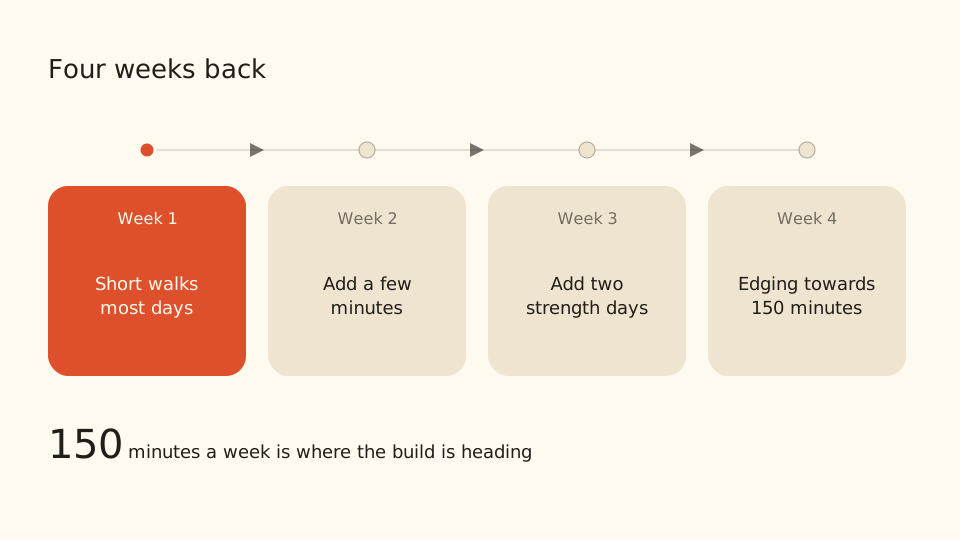
The way to start exercising again is to begin with less than you think you can do and add time slowly. A first week of short walks on most days is enough. Add a few minutes each week, bring in strength work on two days by week three, and build towards 150 minutes of moderate activity a week. A missed week need not send you back to the start, because what counts is how much you do across the weeks, whether or not the active days follow on from each other.
How much should I do in the first week back?
Less than you could manage. The first week is for turning up, not for getting fit, so a few short walks at a pace you can talk through are plenty. For someone who has been inactive, light activity may be the more achievable goal, and any activity is better than none. Pitch the effort at the fitness you have now, not the fitness you had before the break.
Say you’ve had years off and ten minutes is all you can manage. Is that worth doing at all? Ten minutes on five days adds up to 50 minutes, which is a third of the weekly 150 minutes (target) in your very first week. Short bursts count on their own, too. A 2026 study in the British Journal of Sports Medicine looked at 414 inactive adults. They did bursts of five minutes or less, at least twice a day, for 4 to 12 weeks. Compared with the group who did no exercise, their fitness improved significantly.
Recommended watch

How Women Should Workout for Best Results & Injury Prevention
How to train with injury prevention in mind, and working out how much your first week back should hold.
Watch on YouTubeYouTube’s player loads only when you press play.
How do I build up over a month?
Add a little time each week and keep the effort the same. Four steps cover the month:
1. Start with your ten minutes, on five days of the week.
2. Add five minutes to each session every week, on the same five days.
3. Watch the weekly total: 75 minutes in week two, 100 in week three, 125 in week four.
4. In week three, add two short strength sessions as well. Strength work is advised on at least two days a week, and even a little of it counts.
Why grow the minutes so slowly? In one study of inactive adults starting interval training for four weeks or more, about one in six (17.6%) dropped out. The people who dropped out tended to have more minutes of training each week, while how hard the sessions felt made no difference. The minutes in your week are the thing to grow slowly, because in those programmes, it was the training load that predicts if someone quits. If walking is hard on your joints or your weight makes the first steps daunting, exercise when you are very overweight sets out other ways in.
What if I miss a week?
Carry on from the last week you finished, not from week one. The guideline is written as a weekly total, with no rule that the weeks have to be unbroken, so a missed week only means that week’s minutes don’t count, and the weeks you’ve already done still stand.
Do short walks count, or does it have to be a proper workout?
Short walks count. Here is my view on that and four other ideas about getting back into exercise.
| Idea | Our view | Why |
|---|---|---|
| Short walks and brief bouts count | Worth doing | Any activity is better than none, and more is better still. |
| You need 10,000 steps a day | The evidence says otherwise | Longevity benefits start from about 3,000 steps a day, and falls by about 9% for each extra 1,000. More on this in how many steps a day is enough. |
| Miss a week and you lose it all | No evidence either way | The guideline counts weekly totals, not streaks, and no trial tests a missed week. |
| Strength work is essential to keep muscle while losing weight on Mounjaro (tirzepatide) or Wegovy (semaglutide) | No evidence yet | There is no evidence yet on this, however it makes logical sense; strengthening on at least two days a week is advised for all adults regardless. |
Sources
- UK Chief Medical Officers’ physical activity guidelines
- Daily steps and all-cause mortality: an umbrella review and meta-analysis
- Prevalence and predictors of dropout from high-intensity interval training in sedentary individuals: a meta-analysis
- Physical activity guidelines for adults aged 19 to 64
- Effect of exercise snacks on fitness and cardiometabolic health in physically inactive individuals
- High-intensity interval training for reducing cardiometabolic syndrome in healthy but sedentary populations