Exercise when you are very overweight: where to start
A first fortnight in short bouts, a simple way to judge effort by your breathing, and the signs that mean stop and get checked.

In this article
You can start exercise when you are very overweight without losing weight first. Start with a 10-minute brisk walk on five days a week, at a pace where you can still talk, and add five minutes each week until you reach the 150 minutes a week adults are advised to do. Any activity is better than none, and the health benefits come even before the scales move.
What should my first week of exercise look like?
A first week is short, frequent and easy enough to talk through. Aim for moderate effort, which raises your heart rate and makes you breathe faster and feel warmer; if you can still talk but could not sing, you are there. That talk test is the whole of the effort guide for now. If you are too breathless to finish a sentence, slow down, because the first fortnight is about being able to come back tomorrow rather than about how far you get today.
A simple routine for week one: a 10-minute brisk walk on five days, which is 50 minutes, a third of the 150. Keep the same route all week, such as the end of the road and back. Then the only thing you are judging is how your breathing and joints feel.
Which exercise should I start with?
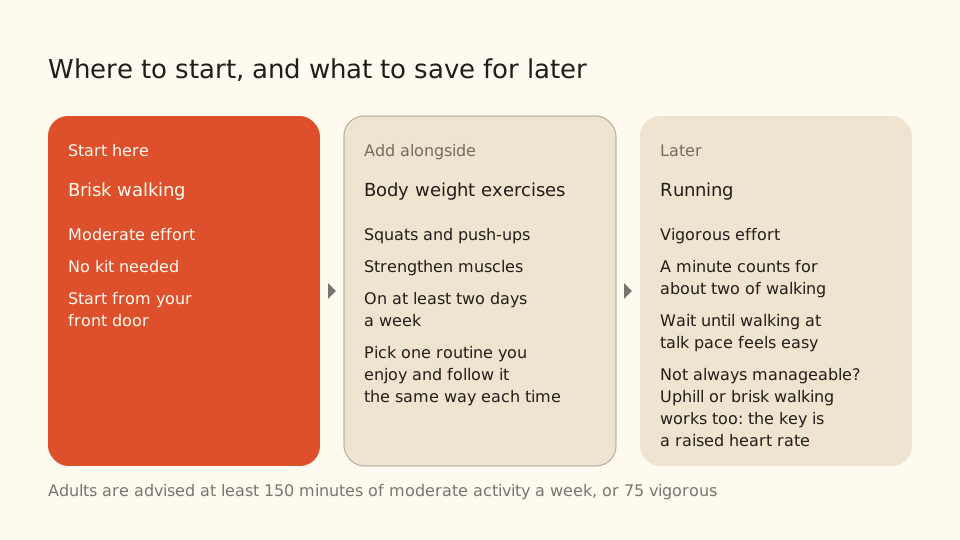
Start with what raises your breathing without hurting, and save the harder options for later. The adult guideline is at least 150 minutes of moderate activity a week, or 75 minutes of vigorous activity, and the common choices sort into those groups like this:
- Brisk walking: moderate effort, needs no kit, and you can start from your front door.
- Body weight exercises, such as squats and push-ups: these strengthen muscles, which adults are advised to do on at least two days a week.
- Running: vigorous effort, so a minute of it counts for about two of brisk walking. Leave it until walking at talk pace feels easy.
If your knees or hips ache, stay at the gentle end of that list for longer. Arthritis UK advises starting slowly and building up gradually, because doing too much too soon can make activity painful and put you off. Steps are another way to count; how many steps a day is enough sets out how they compare.
How do I build up without giving up?
Build up by minutes, a little each week, and only when the week before felt manageable. Week two could be 15 minutes on five days, which is 75 minutes, half the 150; adding five minutes a week brings you to 30 minutes on five days, the full 150, by week five. Five weeks is a pace to aim at, and taking longer is fine. Use the next morning as your test. If a joint is stiff for a few minutes and then loosens up, it has coped. If it is sorer than it was before you started, drop back to what you managed the week before, or try a different activity at the same easy pace.
Do you need to lose weight before you can exercise?
No. The UK Chief Medical Officers’ guidelines recognise the health benefits of physical activity for people with overweight or obesity even when no weight is lost. Waiting until you are lighter puts things in the wrong order, because the activity is doing good whatever the scales say. The same guidelines put it simply: any activity is better than none, and more is better still.
This also changes how to judge progress. If your weight holds steady while your walks get longer, the walking has still worked; why weight loss stalls (article) covers what to look at when the scales stop moving.